High gloss floor tiles: pros, cons and how to choose gloss tile flooringtiles
01 luglio 2020
High gloss floor tiles reflect light, make rooms feel larger and brighter, and give a space an unmistakably high-end finish.
They also come with trade-offs that matter before you commit: a polished surface offers less grip when wet, and it shows footprints and smears more readily than a matte one.
Neither is a reason to rule gloss out — they are reasons to use it in the right places, in the right finish, and to know how to look after it.
This guide covers what gloss tile actually is, its real advantages and drawbacks, how slippery it is and what to do about it, how to clean it without streaks, and where it works best room by room.
What type of tile is glossy? Polished, glazed and lappato finishes
“High gloss” describes a finish, not a material. Three routes produce a shiny tile, and they behave differently underfoot and in maintenance.
| Finish | How the shine is made | What it means in use |
|---|---|---|
| Polished porcelain | The fired surface is ground smooth with abrasive heads | The brightest, most mirror-like; smoothest underfoot |
| Lappato / semi-polished | Partial polishing leaves some matte micro-texture | Softer sheen with a little more grip than full polish |
| Glazed gloss ceramic | A glossy glaze is applied and fired onto the body | Common on walls and backsplashes; less suited to busy floors |
For floors, porcelain in a polished or lappato finish is the durable choice: the body is fired dense and virtually non-absorbent, so it resists water and stains far better than glazed ceramic or natural stone. Glazed gloss ceramic is best kept to walls and backsplashes, where wear is minimal.
High gloss floor tiles: pros and cons
The honest balance sheet, before the design inspiration.
| Factor | The advantage | The trade-off |
|---|---|---|
| Light | Reflects daylight and lamplight; brightens dark rooms | Can produce glare in very sunny rooms |
| Space | Visually enlarges small rooms and narrow hallways | Large expanses can read cold without warm materials |
| Grip | Fine in dry areas such as living rooms and hallways | Less traction when wet — the key limitation |
| Cleaning | Non-porous surface wipes clean; nothing soaks in | Shows footprints, dust and streaks more visibly |
| Durability | Porcelain resists stains, water and heat | Polished finishes are usually rated for lighter traffic |
Are high gloss floor tiles slippery?
Yes — when wet, a high gloss floor is more slippery than a matte or structured one, and it is important to be straightforward about that. A polished surface has almost no micro-texture, so there is little for the sole of a shoe or a bare foot to grip once water, oil or soap is on it. Dry, a gloss floor is no more hazardous than any other hard floor; the risk is specific to wet conditions. That is why the practical question is not whether to avoid gloss, but where to use it and which finish to specify.
How to use gloss flooring safely
Put full gloss where floors stay dry — living rooms, dining rooms, hallways, bedrooms and feature walls. In bathrooms, wet rooms, kitchens and entrances, either move the gloss to the walls and keep the floor matte or structured, or specify a slip-rated finish. Emilgroup’s Tele di Marmo Crystal illustrates the choice well: the same marble look is available either as a glossy Full Lappato or as Silktech, a soft-touch surface rated R10 for better grip. Beyond the tile itself, absorbent mats at entrances and beside sinks, prompt drying of spills, and smaller formats with more grout lines in wet zones all add traction.
Do high gloss tiles scratch easily or show marks?
Porcelain is fired dense and hard, so gloss tile resists scratching well — blades and cookware will not mark it in normal use. What changes with a polished finish is not how hard the surface is, but how visible any wear becomes: a mirror-like surface reveals fine scuffs, dust and footprints that a matte finish would hide. Grit trodden in from outside is the usual culprit, which makes doormats and regular dry dusting genuinely preventive rather than merely cosmetic.
Manufacturers reflect this in how they rate finishes. On Tele di Marmo Revolution, for example, the matte Naturale surface is rated for heavy commercial use while the glossy Full Lappato is rated for light commercial use — a useful signal that gloss belongs in residential rooms and lower-traffic spaces rather than a busy shop floor.
How to clean high gloss floor tiles without streaks
Streaks are almost always residue, not dirt. Too much detergent, the wrong product, or skipping the rinse leaves a film that dries unevenly and catches the light. The routine below removes that variable.
- Dry-clean first with a microfibre mop or soft broom. Lifting grit before it is dragged around prevents micro-scratches on a polished surface.
- Wash with a pH-neutral cleaner well diluted in plenty of warm water — Emilgroup’s guidance for porcelain is a neutral solution and a soft cloth, and more water rather than more product.
- Rinse with clean water. This is the step most often skipped and the single biggest cause of streaking.
- Dry with a clean microfibre cloth while the floor is still damp, working in one direction, to stop water marks from forming as it air-dries.
What to avoid: waxes, oil-based products and anything sold as a shine restorer or gloss polish. They build a film that dulls and streaks over time, and porcelain does not need them. Abrasive powders and scouring pads will damage a polished surface permanently.
Do high gloss tiles need a sealer?
Unlike natural stone, porcelain is virtually non-absorbent and does not require routine sealing to resist stains. Products sold as high gloss tile sealers are generally unnecessary on porcelain and can leave exactly the film that causes streaking. Follow the manufacturer’s care instructions for your specific finish — Emilgroup publishes dedicated guidance for its Full Lappato surfaces — and see our detailed articles on lapped porcelain stoneware and how to clean porcelain stoneware for the full method, including post-installation cleaning.
Are glossy tiles outdated? How to use gloss in a modern scheme
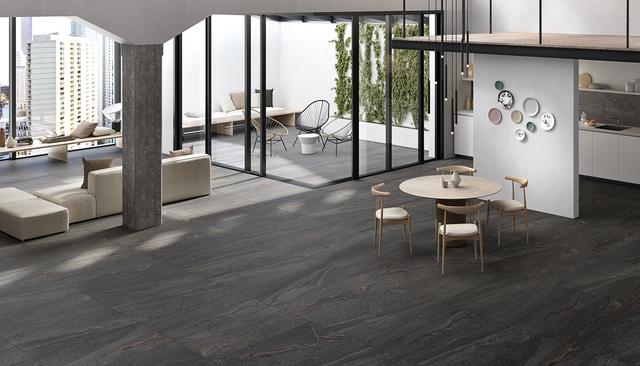
Gloss is not outdated, but the way it is used has changed. Where wall-to-wall shine was once the default statement of luxury, the current approach is more selective: matte and textured surfaces carry the large floor areas, and gloss is deployed where its reflectivity earns its place — a dark or north-facing room that needs light bounced into it, a feature wall, a backsplash, a compact bathroom, or a large-format floor in a formal living space.
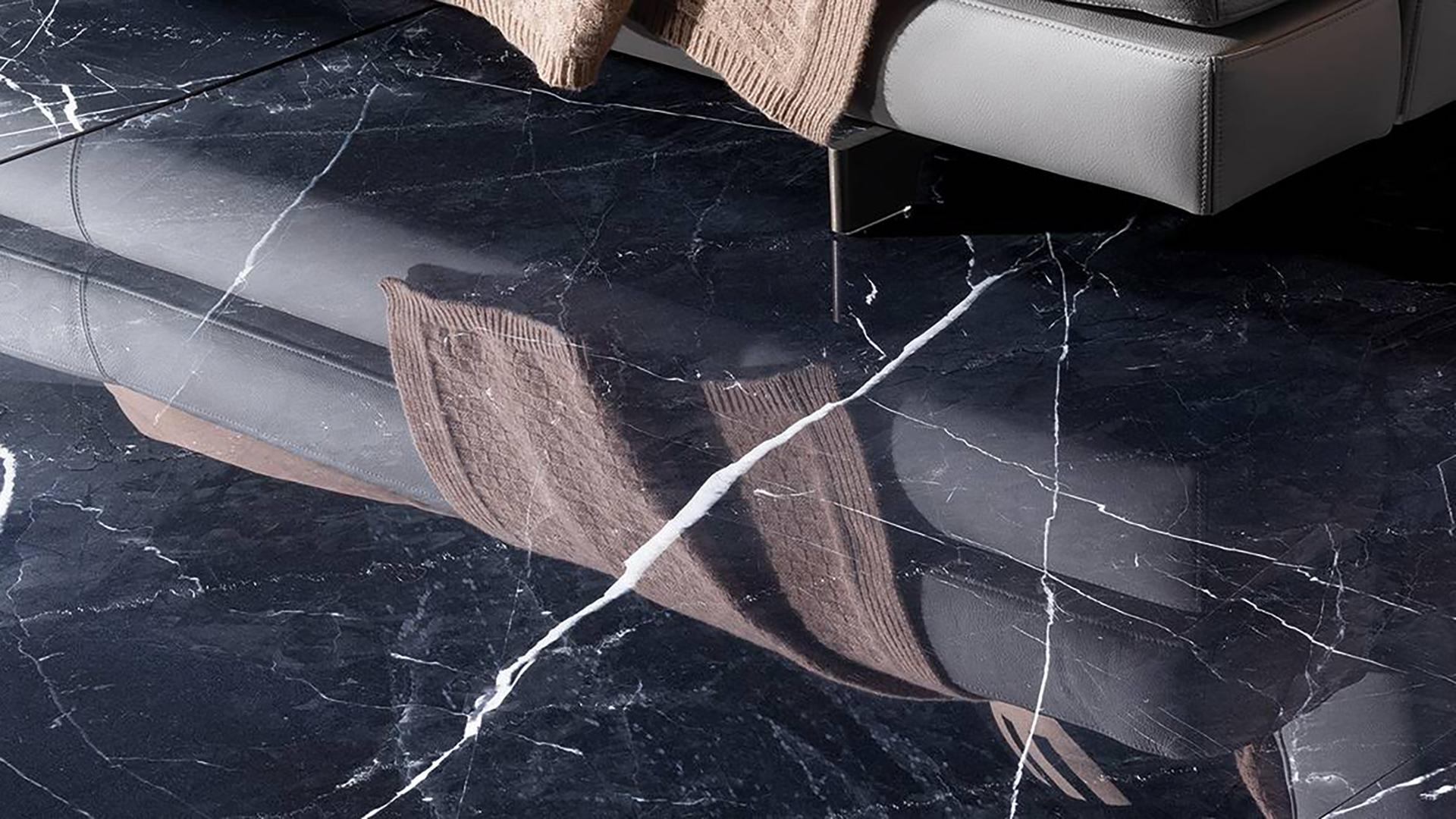
Three habits keep a gloss scheme current. Mix finishes deliberately, setting a polished floor against matte joinery, raw metal or timber so the shine reads as a decision rather than a default. Go large format, because fewer grout lines make a reflective surface look like a continuous plane instead of a grid. And let the material do the talking: a veined marble effect in gloss has depth that a flat, uniform shine does not.
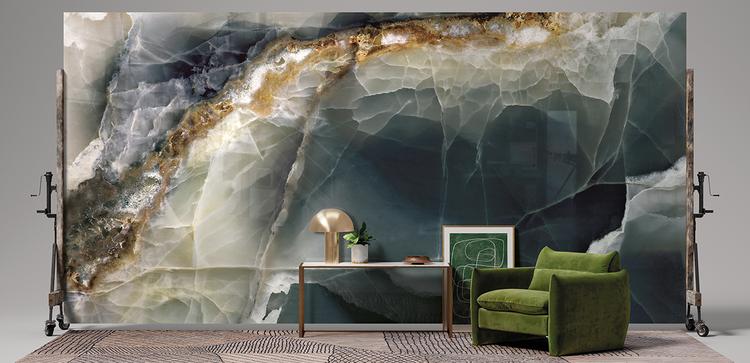
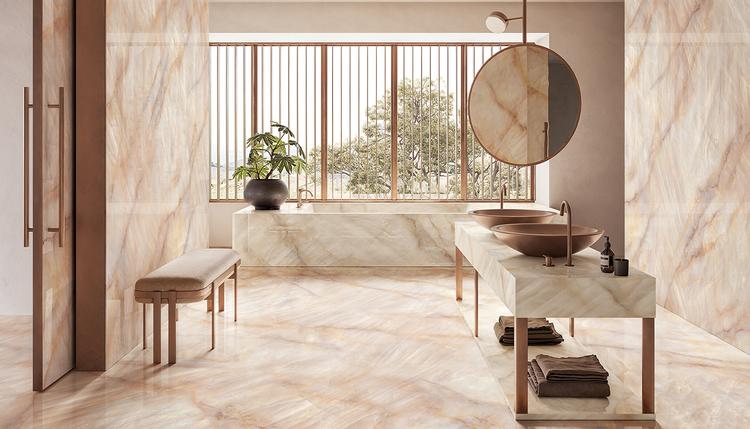
For dark, dramatic gloss, Tele di Marmo Revolution offers Calacatta Black alongside Thassos, Verde Saint Denis and Blu Ande, in natural and semi-polished marbles that reach their fullest expression in the largest slabs — up to roughly 47″ x 109″ — with the Acanto mosaic pattern available for a more decorative treatment.
High gloss tile in the bathroom and shower
A bathroom is where gloss pays off visually and where slip resistance matters most, so split the two. Run the gloss up the walls and into the shower enclosure, where its reflectivity makes a compact room feel larger and brighter, and specify a matte or slip-rated surface underfoot. If you want glossy tiles on a bathroom floor, choose a slip-rated finish such as Silktech R10 rather than a full polish, keep the format smaller so there are more grout lines, and place absorbent mats where water lands.
High gloss tile in the kitchen and backsplash
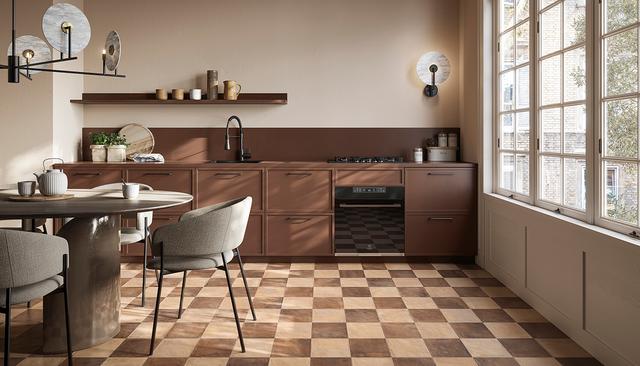
The kitchen splits the same way: a glossy backsplash is easy to wipe down and bounces light across the worktop, while the floor is better matte or lappato because of spills underfoot. Large slabs let one marble effect run from backsplash to worktop for a continuous look — Level Marmi is made for this, in slabs up to roughly 63″ x 127″ and carrying NSF certification for food-contact safety, which matters on a work surface.
Glossy floor tiles for living rooms and hallways
This is where full gloss belongs. Living rooms, dining rooms and hallways stay dry, so the slip trade-off largely disappears and the benefits remain: light carried deeper into the room, a sense of extra space in narrow hallways, and a formal, polished finish. Balance the reflectivity with textiles, rugs and warm timber so the room feels inviting rather than austere, and consider where a pendant or chandelier will read in the floor — a reflected light source becomes part of the scheme.
Frequently asked questions
Is high gloss tile a good choice for underfloor heating?
Yes. Porcelain conducts heat efficiently and is one of the better floor coverings to pair with underfloor heating, gloss or matte. The finish makes no meaningful difference to heat transfer; tile thickness and correct installation matter far more.
Does high gloss tile show water spots in hard-water areas?
It can. Where water is hard, evaporating droplets leave mineral deposits that are more visible on a reflective surface. Drying the floor after washing, and wiping splashes near sinks and showers, prevents the build-up that would otherwise need descaling.
Can high gloss tiles be used outdoors?
They should not be used on outdoor floors. Polished surfaces lose grip in rain and can be affected by frost cycles in exposed installations. For terraces and patios, choose a structured, slip-resistant finish instead, and save gloss for sheltered indoor spaces.
Is gloss or matte tile better for a small, dark room?
Gloss, in most cases. Reflectivity is precisely what a room short of natural light needs, and the visual gain is greatest in compact spaces. The exception is a small bathroom floor, where slip resistance should take priority over brightness.
How much does the format affect how a gloss floor looks?
Considerably. Large slabs with minimal grout lines read as one continuous reflective plane, which is the contemporary look; smaller formats break the reflection into a grid, which reads more traditional and also adds grout texture underfoot.
Will a gloss floor make an open-plan space feel colder?
It can, if reflectivity is the only thing in the room. Pairing a polished floor with rugs, upholstery, timber and matte joinery keeps the warmth while retaining the light-bouncing benefit — the contrast between finishes is what stops the space feeling clinical.
Collections used in the project



Related Articles



Any Questions?
If you are looking for the ideal covering for your home or business or you have any questions about our collections, don’t hesitate to get in touch! Together we’ll find your perfect bespoke solution!
If you are looking for the ideal covering for your home or business or you have any questions about our collections, don’t hesitate to get in touch! Together we’ll find your perfect bespoke solution!
Enter the Emilgroup world!
Stay up to date with the latest news from the world of ceramics. Find out about our new collections, events and innovative applications of porcelain stoneware.